Maths & Puzzles
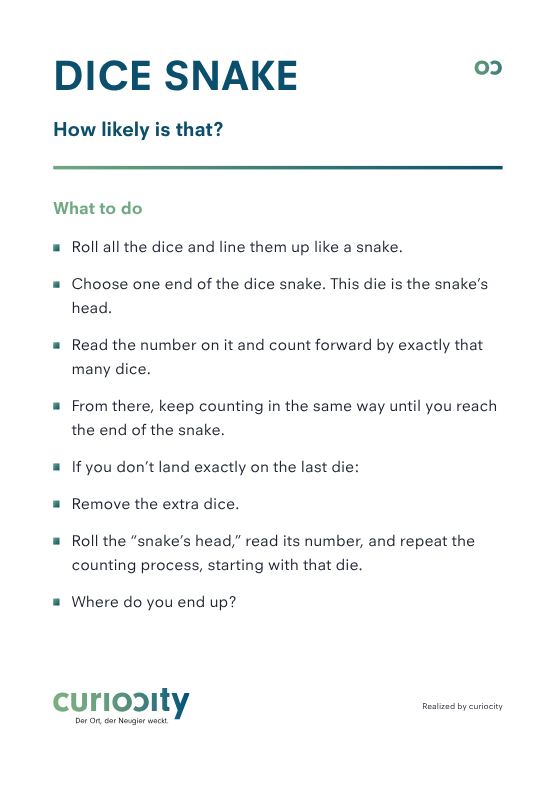
Dice Snake

How likely is that?
How likely is that?
The Science Behind It
At each step, you decide how many positions to move forward. This creates fixed paths through the snake that repeatedly cross and converge. Many paths eventually lead to the same endpoints. With each round, the probability of landing on one of these “gathering points” increases. This behavior can be described mathematically and belongs to probability theory, the branch of mathematics that studies randomness and probabilities. Although each roll is random, the interaction of many steps creates a recognizable structure. The exhibit shows that randomness is not always completely chaotic and can produce surprising patterns.